How many times a week should I work out? For most people, three times a week is enough to build real strength and muscle, especially in the first year. Two works to get started, and four or five suits you if you have the time and recover well. What matters most is training each muscle about twice a week and keeping it up for months.
The short answer
| Days a week | Who it suits | What the week looks like |
|---|---|---|
| 2 | Busy weeks, or getting started | Two full body sessions, or upper and lower |
| 3 | Beginners and most people | Three full body sessions, or push, pull, legs |
| 4 | Some experience, time to spare | Upper and lower, twice each |
| 5 | Experienced, gym is a hobby | Each muscle split across the week |
More days don't automatically mean more progress. The plan you can keep for six months beats the perfect plan you drop in week three.
Is going to the gym 3 times a week enough?
Yes, for building muscle and strength, three days is plenty for most people. Studies that compare training a muscle once, twice or three times a week find that the total hard work per week matters far more than how many days you spread it over. Three full body sessions give every muscle three chances a week to grow, with a rest day after each.
Three days also fits a normal life: Monday, Wednesday and Friday, or whatever days you actually have free. And it leaves you fresh enough to put real effort into each session, which is where progress comes from.
Is 2 times a week at the gym enough?
To start, or to keep what you have during a busy period, yes. Two sessions of the whole body, or one upper and one lower day, keep every muscle working. You'll progress a bit slower than on three days, because each muscle gets less total work, but it's far better than zero, and many people build the habit this way before adding a third day.
Is the gym 4 times a week better than 3?
It can be, if you have the time and recover well. Four days let you split the body into upper and lower days, train each half twice, and fit in more sets without long sessions. For someone with a year or two of training, that extra room helps. For a beginner, three good sessions usually beat four rushed ones.
Five days or more
Five days work for people who love the gym and recover well. Each session focuses on fewer muscles, and the week still hits each one about twice. Beyond that, the gains get small and the risk of running yourself down grows. You don't need it to make great progress.
Can I go to the gym 7 days a week?
You can move every day: walking, cycling or an easy session is good for you. What doesn't work is training the same muscles hard every day. Muscles grow while they recover, and without rest days the fatigue keeps stacking until the weights stall or something starts to ache.
So even very keen lifters take at least one or two full rest days a week. If you want to be active daily, keep the heavy sessions at three to five and do something light on the other days.
How many times a week should I work out each muscle group?
About twice a week per muscle is a good target. Full body three times a week gives you three. Upper and lower on four days gives you two. A split where each muscle gets only one day a week can work, but it packs a lot of sets into one session. The pros and cons of each layout are in full body or split.
Can I train two days in a row?
Yes. Training on back-to-back days is fine when the sessions work different muscles, like upper body one day and legs the next, or when they are full body sessions of moderate effort. Just avoid two heavy leg days in a row: the second one will be weaker and leave you sorer.
How to choose your number
Look at a normal week and count the days you can honestly get to the gym. Start with that number or one less, train for a month, and add a day if it feels easy. If you're new, three days is the sweet spot: our beginner full body program is built exactly like that, and your first time at the gym covers the first session.
How Coach.AI builds your week
In Coach.AI you choose how many days you train, from one to five, and which days of the week. The coach then picks the split for that number. One day is a full body session. Two days are an upper and a lower day. Three days are full body for beginners, so every movement gets practised three times a week, push, pull and legs for most skilled lifters, and full body again higher up, where every session needs to train every big muscle. Four days are upper and lower twice. Five days are push, pull and legs plus an upper and a lower day.
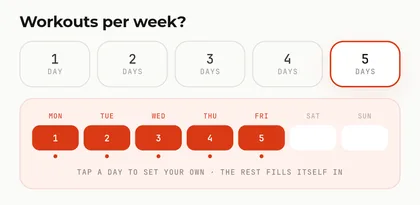
Life gets in the way sometimes. If you miss a few days, the coach sees the gap and can rebuild the rest of your week around it, which uses one .AI generation. Coach.AI plans up to five days a week, never every day.

Questions people ask
How many days a week should a beginner work out?
Two or three. Three full body sessions with rest days in between is ideal: enough practice to learn the movements, enough rest to recover.
Is 3 times a week at the gym too much for a beginner?
No. With a sensible plan and light weights to start, three sessions a week is exactly right for most beginners. Go to two if you're very sore or short on time.
Is it bad to work out every day?
Training the same muscles hard every day is, because they never get to recover. Light activity every day is good. Keep the hard sessions to three to five a week.
Is 4 days a week better than 3 for building muscle?
Only if you use the extra day for more total work and still recover well. For most people, three solid days build muscle just as well, especially in the first year or two.