How long to rest between sets? Two to three minutes between sets of the big lifts like squats, presses and rows, and about a minute to ninety seconds on smaller exercises like curls and raises. Training for strength, go longer. Training to lose weight, a bit shorter. The real test is simple: if the next set still hits its reps with clean form, you rested enough.
How long to rest between sets: the short answer
Most people ask how long to rest between sets while already standing at the rack, so here is the answer first. The numbers are ranges, not a stopwatch you have to obey.
| Goal | Big lifts (squat, bench, row) | Smaller exercises (curls, raises) |
|---|---|---|
| Muscle growth | 2-3 minutes | 60-90 seconds |
| Strength | 3-5 minutes | 90 seconds - 2 minutes |
| Weight loss | 60-90 seconds | 45-60 seconds |
| Endurance | 45-60 seconds | 30-45 seconds |
Heavier sets and bigger muscles need more time. A set of five heavy squats leaves you a lot more cooked than a set of fifteen lateral raises, even if both felt hard. The squat puts a lot of muscle to work at once and drives your heart and breathing up, while a single small muscle refuels and clears its waste much faster. Why that is so comes down to what happens in your body in those few minutes.
What happens in your body between sets
Rest can look like doing nothing. Inside the muscle it is the busiest part of the workout: three things are being put back in order, and each of them takes its own time.
The fast fuel runs low
A muscle fibre can spend only one kind of energy directly, a molecule called ATP, and it keeps just a few seconds' worth on hand. For a hard set lasting under half a minute, the muscle tops ATP up from a small, very fast reserve called phosphocreatine. Think of it as a tiny fuel tank right next to the engine: instant to use, but it empties quickly. A hard set of 8-10 reps drains a big part of it.
When you rack the weight, the tank starts refilling, and it needs oxygen to do it. That is why you keep breathing hard after a set even though you are just standing there. Roughly half of the tank comes back in the first 30-60 seconds, most of it in about three minutes, and the last bit takes a few minutes more.
The burn and the brakes
During a hard set the muscle also piles up leftovers. Hydrogen ions make it more acidic, and that is the burn you feel in the last reps. Phosphate left over from spent fuel gets in the way of the contraction itself, so each fibre pulls less hard than it could a minute ago. Lactate, which usually gets the blame, is mostly innocent: your body turns it back into fuel within minutes. Rest is the time all of this gets cleared away.
The nervous system needs a breather too
To lift something heavy, your brain has to switch on almost every fibre in the muscle and fire them fast. After a very heavy set that signal is a little weaker for a while. That is why a heavy set of three asks for more rest than a set of fifteen, even when both feel equally hard.
Why your strength drops from set to set
Put the three together. Start the next set after 30 seconds and your fuel tank is about half full, the brakes are still on and the signal from your brain is tired. Every rep costs more, the same weight feels heavier, and the reps run out sooner.
Rest decides which of these you let recover fully and which you train on purpose while it is still tired. That is the whole reason the right rest depends on your goal.
Rest between sets for muscle growth (hypertrophy)
A muscle grows mainly from tension: a heavy enough load, moved through many hard reps close to your limit. The reps near the end of a hard set are the ones that send the strongest growth signal, so the more of them you collect across a session, the better.
For a long time the gym rule was "keep rest short for the pump". The pump is real, blood and fluid swelling the muscle, and it feels productive, but it adds much less than the reps themselves. Studies comparing short and long rests on the same program found that people who rested around two to three minutes on the big lifts did more reps over the session and grew at least as well, often better. Short rest simply steals reps.
So for muscle, rest two to three minutes on compound lifts, the ones that move several joints and a lot of weight. On isolation work, a minute to ninety seconds is plenty, because one small muscle refuels and clears its leftovers faster than half your body.
Rest between sets for strength
Strength training means heavy sets of few reps. Those lean almost entirely on the fast fuel tank and on your brain's full signal to the muscle, and both of them are the slowest to come back. Three minutes is a good default on heavy squats, deadlifts and bench presses, and nobody serious will laugh at you for taking four or five before a heavy set of three.
Short rest here does not make you tougher. It makes the next set lighter, and the point of a strength session is lifting the heavy weight with good form, set after set.
Rest between sets for weight loss
Shorter rest makes the session denser: more work in the same hour, a heart rate that stays up, more huffing and puffing. After such a session your body also keeps working a little harder for a while. That feels like fat burning, and it does burn some extra calories, but we are talking tens of calories, not hundreds. Weight comes off mostly through what you eat.
What the gym does in a diet is ask your body to keep its muscle, and that needs sets heavy enough to count. So shorten rest to about 60-90 seconds on big lifts and 45-60 on smaller ones, but stop shortening when the weights start falling apart. Our weight loss program shows what a full week of this looks like.
Rest between sets for endurance
Here short rest is not a compromise, it is the training itself. Starting the next set while the muscle is still acidic and the fuel tank is half full teaches your body to clear the leftovers and refill faster, and pushes your heart and vessels to deliver oxygen better. That is why endurance work uses 30-60 seconds and lighter weights you can move for many reps.
A rest table by exercise
| Exercise | Rest |
|---|---|
| Squat, deadlift | 2-4 minutes |
| Bench press, barbell row, overhead press | 2-3 minutes |
| Leg press, machine press, dumbbell press | 90 seconds - 2 minutes |
| Curls, raises, extensions, calves | 60-90 seconds |
| Abs and bodyweight exercises | 30-60 seconds |
| Superset partners | 0-30 seconds between, 90 seconds - 2 minutes after the pair |
In a superset you go from one exercise straight to the other, then rest after the pair. It works best with exercises that do not fight over the same muscle, like a press and a row.
What happens if you rest 30 seconds or 4 minutes
With 30 seconds between sets of a big lift, your fast fuel is only about half back and the leftovers from the last set are still there. You will usually lose a few reps on every set and finish with less total work. Fine for a finisher at the end of a session, poor for your main lifts.
With 4 minutes, nothing bad happens. The tank is practically full and the muscle has cleared out. On heavy lifts it is often exactly right. On a set of curls it is just a long workout, because a small muscle was ready long ago. If you are short on time, cut the rest on the small exercises and keep it on the big ones.
How to tell your rest is right
- Your breathing is back to normal, or close: a good sign the fuel tank has mostly refilled.
- You feel ready to give the next set a real effort.
- The next set hits the reps your plan asks for, or one fewer at most.
If you keep missing reps on the third and fourth set, add thirty seconds. If you are ready long before the timer, try a little less.
Rest between exercises works the same way: take what you need to set up the next one, usually two to three minutes, plus the warm-up sets if it is a heavy lift.
How Coach.AI times your rest
In Coach.AI the rest timer opens on its own as soon as you log a set, already set to the right length. You don't have to remember any of the table above.
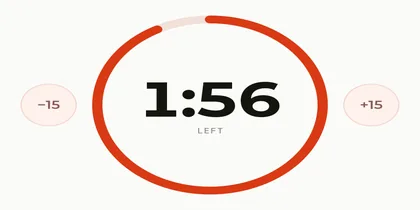
The length comes from your plan. It depends on your goal and on whether the exercise is a big compound lift or a smaller one. On a muscle plan that is about 2 minutes on the big lifts and 75 seconds on the smaller ones, and on a strength plan it grows from 2.5 to 3 minutes as the sets get heavier over a block. A weight loss plan makes the rest shorter week by week, from 90 seconds to 60 on the big lifts, which is where the periodization of that goal lives.
Age changes it too. From your thirties the break gets gradually longer: about 15 seconds more by 40 and 30 seconds more by 60. Bodyweight exercises never get more than 90 seconds, and in a superset you move to the partner exercise with only its own short rest and take the long break after the round. If the quick check-in before your workout comes out low, the rests that day get a little longer.
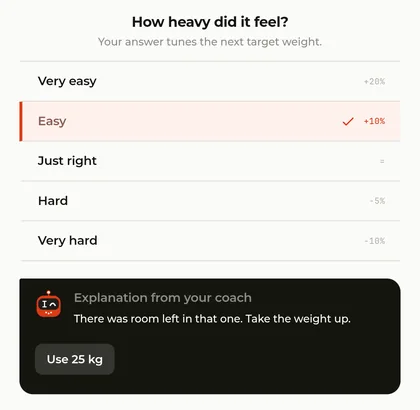
On the timer you can add or take off 15 seconds, or skip the rest. While it runs, it asks how heavy the set felt, from "Very easy" to "Very hard", and the coach answers with what to do on the next set: hold the weight, add a step or take some off.
Questions people ask
Is 1 minute rest between sets ok?
For smaller exercises, abs and lighter sets, yes. For heavy squats, deadlifts and presses, one minute is usually too short: you will lose reps on the next set. Give those two to three minutes.
Is 2 minute rest between sets too much?
No. Two minutes is a normal, even moderate, rest for big lifts, whether you train for muscle or strength. It only feels long on light isolation work, where 60-90 seconds does the job.
Should I rest longer as I get older?
Usually a little, yes. Recovery between hard efforts slows down with age, so an extra 15-30 seconds on the big lifts helps keep every set honest. Let the next set decide: if it still hits the reps, the rest was enough.
Do I time rest from the end of the set or the start?
From the end. The clock starts when you rack the weight and stops when you start the next set. Coach.AI does the same: the timer starts the moment you log the set.