Periodization training means planning your weeks so the work builds, peaks and backs off on purpose, instead of repeating the same workout or adding weight whenever you feel strong. A program built this way tends to get you to your goal faster, for plain reasons: every week has a job, recovery is part of the plan, and progress gets measured instead of guessed.
Why a planned program gets you there faster
Most of us train in one of two ways. Some repeat the same workout every week, same weights, same reps, for months. Others add weight on good days and back off on bad ones. Both feel like training. Both stall.
The first stalls because your body adapts to what you ask of it and then stops. The second stalls because good and bad days are random, so the plan is too: you push hard on Tuesday, pay for it on Thursday, and a month later you're lifting what you lifted a month ago.
A periodized program fixes this with structure:
- A planned build-up. Each week is a little harder than the last by design, not by mood.
- Recovery built in. An easier week comes before fatigue turns into a stall or a sore shoulder.
- Progress you can measure. A cycle ends with a test, so you know what worked.
- Variety with a reason. Reps and rest change from week to week, so your body keeps getting a new reason to adapt.
- No burnout. You know when the heavy week comes and when it ends, which makes it far easier to keep showing up.
To be honest about the research: studies comparing periodized and non-periodized programs generally find an edge for periodization, clearest for strength. For muscle size the results are closer, and the bigger win is practical: you keep progressing for months instead of hitting a wall after six weeks. Nobody can honestly promise you "30% faster", and I won't.
What periodization actually is
It's planning on three scales. The week (a microcycle) decides which sessions you do and how hard. The block (a mesocycle), usually three to six weeks, has one direction and ends with an easier week or a test. The program (a macrocycle) chains several blocks toward a goal. The mesocycle matters most in the gym: long enough for a real change, short enough to see its end.
Linear vs undulating vs block periodization
There are three classic ways to arrange the work:
| Model | How it works | Good for |
|---|---|---|
| Linear | Reps go down and weight goes up, week after week | Beginners, simple strength goals |
| Undulating | Reps change from day to day or week to week | Breaking monotony, training several qualities |
| Block | Each block has one focus: volume, then intensity, then a peak | Experienced lifters aiming at a test date |
Linear works great at first and runs out, because the weight can't climb forever. None of them is magic.
How Coach.AI uses periodization
I built Coach.AI so you never have to plan any of this yourself.
Program length depends on your level: 8 weeks for Beginner, 12 for Skilled, 16 for Advanced. Every program is made of four-week blocks.
Each block is three loading weeks and a lighter fourth. Across the loading weeks the reps move in a wave, and the wave depends on your goal:
- Build muscle: 10, 8, 6 reps on the main lifts, 15, 12, 10 on the smaller ones.
- Strength: 5, 4, 3, with rest growing from 150 to 180 seconds.
- Lose weight: reps stay around ten while rest on big lifts shrinks from 90 to 60 seconds.
- Endurance: reps climb by two a week (13, 15, 17) while the weight holds, and the next block starts heavier.
- Stay fit: a gentle 12, 10, 8.
So it's undulating inside the block and linear across it. Fewer reps means a heavier bar, because the weight the coach suggests is always worked out for today's reps. Here is one real block from the push pull legs program on this site:
| Week | Bench press | Rest | Sets that week |
|---|---|---|---|
| 1 | 4 × 10 | 120 s | 71 |
| 2 | 4 × 8 | 120 s | 72 |
| 3 | 4 × 6 | 135 s | 72 |
| 4, lighter | 2 × 10, about 20% lighter | 120 s | 41 |
The lighter week goes back to week one's reps and rest, drops the main lifts to two sets and takes weight off: about 20% at Skilled, 25% at Advanced. If your goal is to stay fit, that week gets fewer sets but keeps the weight. The deload week article explains why.
Advanced programs are proper block periodization. The first two blocks build volume with two extra reps on the main lifts, the third turns it into intensity with a rep fewer and about a tenth less work, and the fourth peaks with the fewest reps of your goal's wave and about a quarter less work. Advanced programs test halfway and at the end.
Beginners: no planned lighter week, on purpose
New to the gym and under 60? Your program has no planned lighter week. A beginner has little fatigue to shed and needs practice most, so a lighter week would cost a week of learning and buy almost nothing. Your fourth week simply starts the wave again. The first week of a first program is gentle instead: two sets per exercise and the same four base lifts in every session. From 60, the lighter week is part of the plan at every level, because recovery becomes the main limit.
Your log steers every next week
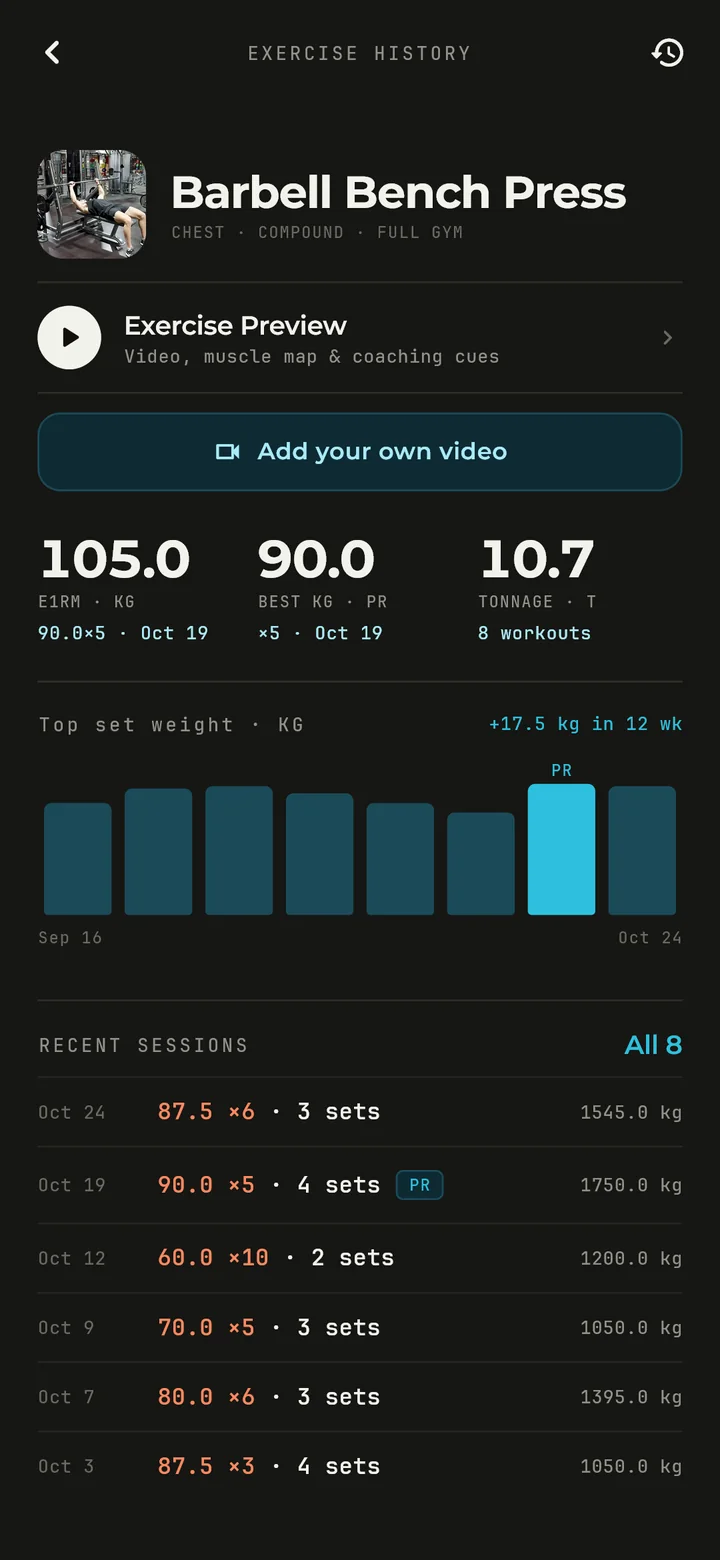
A plan on paper is only half of periodization. In Coach.AI you get the next week when you finish the current one, built from the sets you logged. A muscle you trained for most of what was planned gets one more set a week; one you skipped holds. If you logged nothing, the week repeats instead of getting harder. A lift where you hit the reps at a manageable effort moves up a step, missed reps bring it down about 10%, and a lift stuck for three sessions is swapped for another exercise for the same muscles. More in progressive overload.
When your sessions keep coming out very hard and your check-ins keep coming out low, the lighter week comes early. A beginner program without lighter weeks doesn't get one early either.
Test day, then the next program
Every program ends with a test day; past the beginner level it falls in a lighter week, so you measure on a rested body. What gets measured follows your goal: a strength program works up to one heavy set of a few reps, a muscle program takes the block's working weight for as many clean reps as you can, and weight loss and endurance measure reps and work against the clock. When a lift is tested for weight, that number becomes the starting point for your next program, in both directions: if you guessed too high at the start, the test corrects it.
Then the next program continues instead of starting over. Each level has stages, and steady training moves you up about one stage per program. The new program opens at about 90% of the volume the last one finished on, so you never throw away what you built. After six weeks or more away it starts gently, a stage back.
To see how the weeks stack up, look at the upper lower program week by week, or browse all programs.
Questions people ask
Do beginners need periodization?
Not the complicated kind. In your first months almost anything that adds a little weight or a rep each week works. What you do need is the same lifts repeated often and a plan that grows step by step, which is how a beginner program in Coach.AI is built.
How long is a training block?
Usually three to six weeks. Coach.AI uses four: three loading weeks and, from Skilled up, a lighter fourth. Long enough for the wave to work, short enough that an easier week is never far away.
What if I miss a week?
Nothing breaks. The plan waits for you: if you logged nothing, the next week repeats the last one instead of getting harder. After six weeks or more away, the next program starts gently and a stage lower.
Is periodization only for athletes?
No. It started in sport, but the idea is simply to plan hard weeks, easier weeks and a check of your progress. Anyone who lifts for more than a couple of months benefits, especially once the quick early gains slow down.