Progressive overload means asking your body for a little more than last time, so it has a reason to get stronger. More weight is the obvious way, but more reps, more sets, cleaner form and shorter rest count too. The whole skill is in the size of the step: small enough to keep, big enough to matter.
What progressive overload means
Your body adapts to what you ask of it, and then it stops. Bench 60 kg for three sets of ten every Monday for a year, and you get very good at exactly that. Nothing in that workout asks for more.
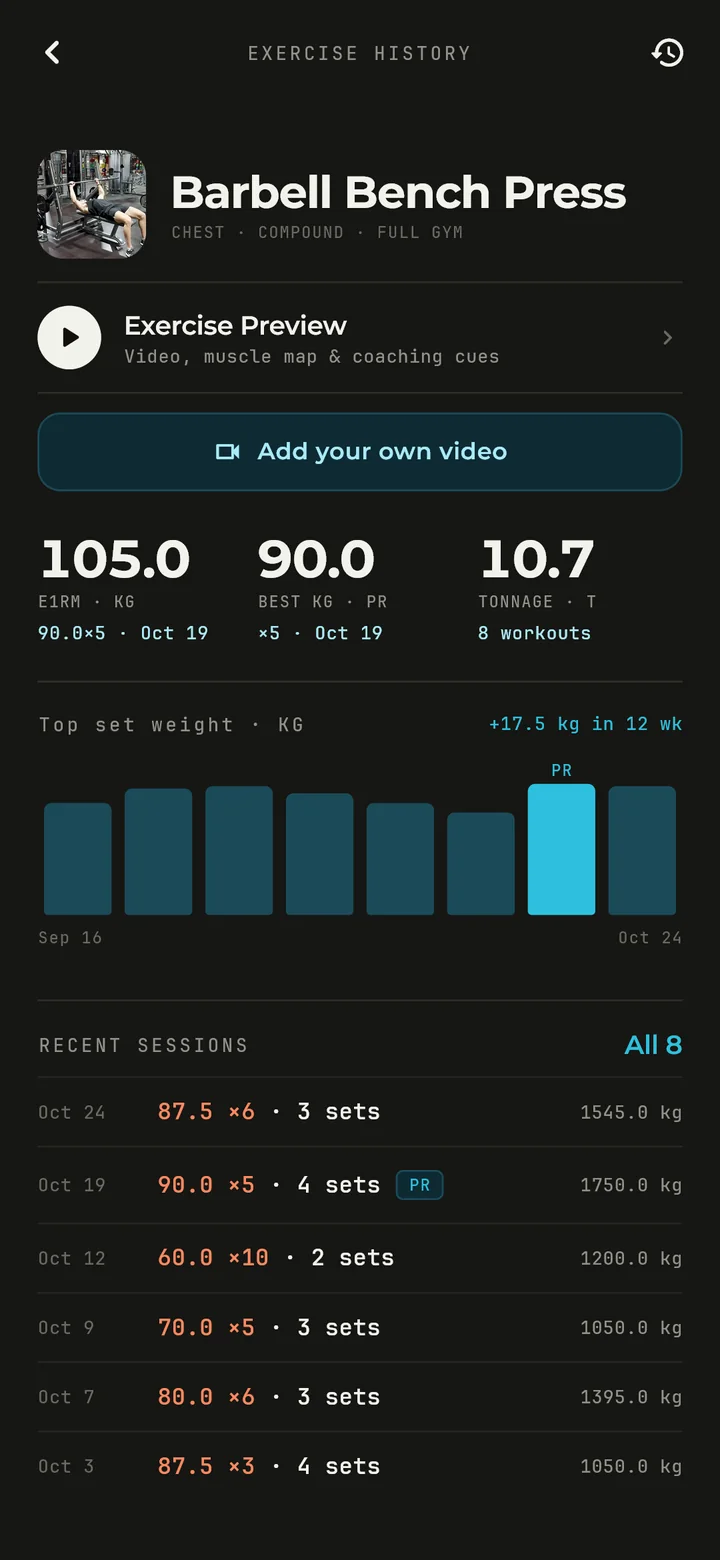
Progressive overload is the fix: every so often the work gets a little harder, and the body keeps adapting to catch up. Every program that works has it, whether it's a three day full body or a five day split. The catch is that most of us don't track it. We walk up to the rack, try to remember last week, and pick the same weight as last month because it feels safe. That's not overload, that's a habit.
Five ways to make a workout harder
- More weight for the same reps.
- More reps with the same weight.
- More sets for the same exercise.
- Better reps: a fuller range of motion and a slower, controlled lowering. Same numbers, more work for the muscle.
- Shorter rest: the same work in less time.
For most people who train with weights, the first two carry almost everything. Extra sets are a slower dial, and shorter rest suits fat loss and conditioning better than strength, where you need the full pause to lift well.
Why jumping too fast backfires
You feel great, you add 10 kg, and the first set goes fine. The second stops at six reps instead of ten, your lower back joins in, and next week you quietly go back to the old weight. Net progress: zero, plus a sore joint.
Muscles adapt faster than the joints and tendons around them, so small steady steps beat big brave ones. Think in percentages, not kilos: 2.5 kg is about 4% on a 60 kg bench press, but going from 10 kg to 12 kg dumbbells on a curl is 20%. That's why small exercises progress mostly on reps, and big ones on weight.
Double progression: the simplest plan that works
Pick a rep range, say 8-12. Keep the same weight until you hit the top of the range on every set with clean form. Then add the smallest jump and go back to the bottom of the range. Here's a bench press with three sets:
| Week | Weight | Reps per set |
|---|---|---|
| 1 | 60 kg | 10, 9, 8 |
| 2 | 60 kg | 11, 10, 9 |
| 3 | 60 kg | 12, 11, 10 |
| 4 | 60 kg | 12, 12, 12 |
| 5 | 62.5 kg | 9, 8, 8 |
The weight sat still for four weeks and you still progressed every week. Reps are progress too. Real life is messier than a table, and some weeks you'll stand still. That's normal.
Not sure where to start? Put a recent set you trust into the 1RM calculator and it turns into working weights for any number of reps.
How Coach.AI does this for you
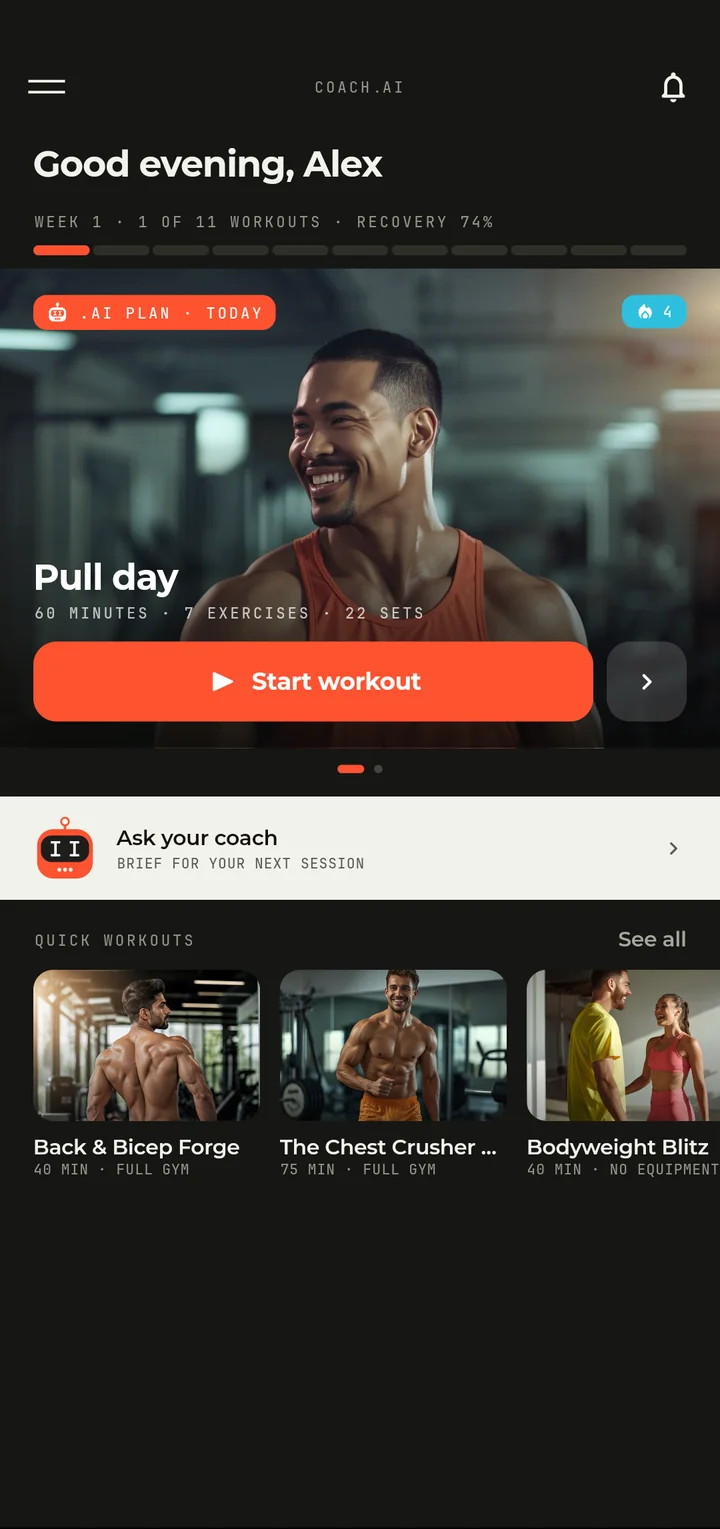
Remembering numbers between sets is exactly where most of us fail, so I built Coach.AI to do it. The plan reads what you actually logged and moves the numbers itself.
Between sets. After every set the rest timer asks how it felt: very easy, easy, just right, hard or very hard. Each answer shows what it does to the next set (+20%, +10%, the same, -5%, -10%), and the coach's weight moves with it. Fall three or more reps short of the card, and the next set comes down 10%.
Your next workout. The app picks the set that stands for the session: the heaviest one that hit the card's reps and felt just right or hard. That weight carries over. If every set felt easy, the last one goes up 10% (20% if very easy). If the only sets that reached the target felt very hard, or none reached it, the weight comes down 10%. Extra reps count too: 12 where the card said 10 means a heavier number next time, and the finish screen shows it with the reason.
Week to week. The plan runs in four-week blocks, and the reps move on purpose: 10, 8, 6 on the main lifts of a muscle block, 5, 4, 3 in a strength block. The weight is always worked out for today's reps, so fewer reps means a heavier bar for the same strength. Endurance goes the other way: reps climb by two a week while the weight holds, and the next block starts heavier. For weight loss the reps stay around ten and the rest on big lifts shrinks from 90 to 60 seconds.
When the plan writes next week, a lift whose reps you topped at a manageable effort moves up a step: 2.5 kg or less on most lifts, 5 kg on the main lifts of a strength block. A step is held to about 7.5% of the bar, so that 5 kg only kicks in past roughly 65 kg. A low score on the check-in before the workout brings the day's weight down a little. A lift that hasn't moved for three sessions in a row is swapped for another exercise for the same muscles.
Without weights. On push-ups the dial is reps: just right adds one, easy adds two, hard holds. At the ceiling for your goal (12 for strength, 20 for muscle, 25 for staying fit, 30 for weight loss or endurance) the coach asks you to add weight. Planks grow by five seconds a step.
Past the beginner level, every fourth week is lighter. A program runs 8, 12 or 16 weeks depending on level and ends with a test day. See how the weeks build on the beginner full body program, or browse the free programs.
Questions people ask
How often should I add weight?
As often as the reps allow. In your first months that can be every week or two on the big lifts; later it slows to once every few weeks. Let the top of your rep range decide, not the calendar.
What if I stall?
Check sleep, food and stress first. Then drop the weight about 10% and climb back over a couple of weeks; you'll usually pass the old number. If a lift still won't move after three sessions, switch to another exercise for the same muscles. Coach.AI makes that swap on its own.
Should I always add weight?
No. More reps, an extra set, cleaner reps and shorter rest all count. Holding the weight on a flat day is smart training, and a lighter week now and then is part of the plan.
How do I do progressive overload with dumbbells at home?
Home dumbbells jump in big steps, so lean on reps: let the range run up to 15-20 before you pick up the next pair. Add a set, slow the lowering to three seconds, or switch to one arm or one leg at a time. In Coach.AI you tell the app what equipment you have, and the plan only uses that.