A deload week is a planned lighter week in the gym, usually after three to six weeks of hard training. You keep the same exercises but do fewer sets, a lighter weight, or both, so the fatigue you have piled up can fade and the strength you built underneath it can show.
What a deload week actually is
Every hard week in the gym leaves two things behind. One is the fitness you came for: a bit more muscle, a bit more strength. The other is fatigue. Your joints get cranky, your sleep gets lighter, and the bar that flew up two weeks ago now feels filled with sand.
Fatigue fades faster than fitness. Ease off for a week and the tiredness clears in days, while the strength you earned stays. That is the whole deload week meaning: you train lighter on purpose, so you return to the hard weeks fresher than you left them.
It is not a holiday. You still go to the gym, still squat and press, still log your sets. You just do noticeably less.
Why lifting less can make you stronger
Progress does not happen during the hard set, it happens while you recover from it. If recovery never quite catches up, the gap grows a little every week until the weights stall or something starts to hurt. A deload closes that gap, and afterwards most people find their working weights feel lighter than before. That is not magic, it is the fatigue that was hiding your real strength finally getting out of the way.
Signs you need a deload
Two or three of these together are a good hint:
- The same weight feels heavier than last week, for no clear reason.
- A lift stalls for two or three sessions in a row.
- Joints or tendons ache in a way they normally don't.
- You sleep worse and walk into the gym already tired.
- Training stopped being something you look forward to.
One bad day is not a sign, everyone has those. A pattern over a week or two is.
Deload by volume or by intensity
There are two dials you can turn:
| Type | What changes | What stays |
|---|---|---|
| Volume deload | About half the sets | The weight, roughly |
| Intensity deload | The weight drops 10-25% | The number of sets |
| Both | Fewer sets, lighter bar | The exercises |
Cutting volume is gentler and keeps your technique sharp on familiar loads. Cutting intensity gives joints and nerves more of a break. With a few months of lifting behind you, a bit of both works well.
Deload week vs week off
A deload keeps the habit and the movement patterns alive, so the first hard week afterwards does not feel like starting over. A full week off is the better call when you are sick, injured, travelling, or so busy that the gym itself would be one more source of stress.
Tired from training? The lighter week usually wins. Tired of everything? Take the week off and don't feel guilty about it.
How to do a deload week in the gym
- Keep the same exercises and the same days.
- Cut the sets roughly in half. Four sets become two.
- Take 10-20% off the weight, or keep it and drop the sets further.
- Stop every set well before failure.
- Drop supersets and circuits, rest normally.
- Keep sleeping and eating well. Recovery is the point.
Sessions get shorter, which is a nice side effect. Enjoy it.
How Coach.AI plans the lighter week
Coach.AI builds programs in four-week blocks: three weeks where the work climbs and a fourth that is lighter. Weeks 4, 8, 12 and so on are your lighter weeks, so you don't have to guess.
In that week the main lifts drop to two sets, and the reps and rest go back to week one's. Supersets are left out, because packing work together is the opposite of recovering. In the upper lower program on this site, week 3 has 87 working sets and week 4 has 45, and sessions take about 33-44 minutes instead of 56-79.
The weight comes down too. With some training behind you, the weight the coach suggests is about 20% lighter than usual, and about 25% at an advanced level. With age the cut gets a little deeper. If your goal is simply to stay in shape, the week is quieter rather than lighter: fewer sets, same weight. Nothing climbs that week, and afterwards the plan picks up from where your block stood.
Want to see what lighter means in kilos for your own lifts? The 1RM calculator turns a recent set into a table of percentages.
For people with some experience, the last week of the program is lighter too and ends with a test day, so you measure progress on a rested body.
When your body asks for it early
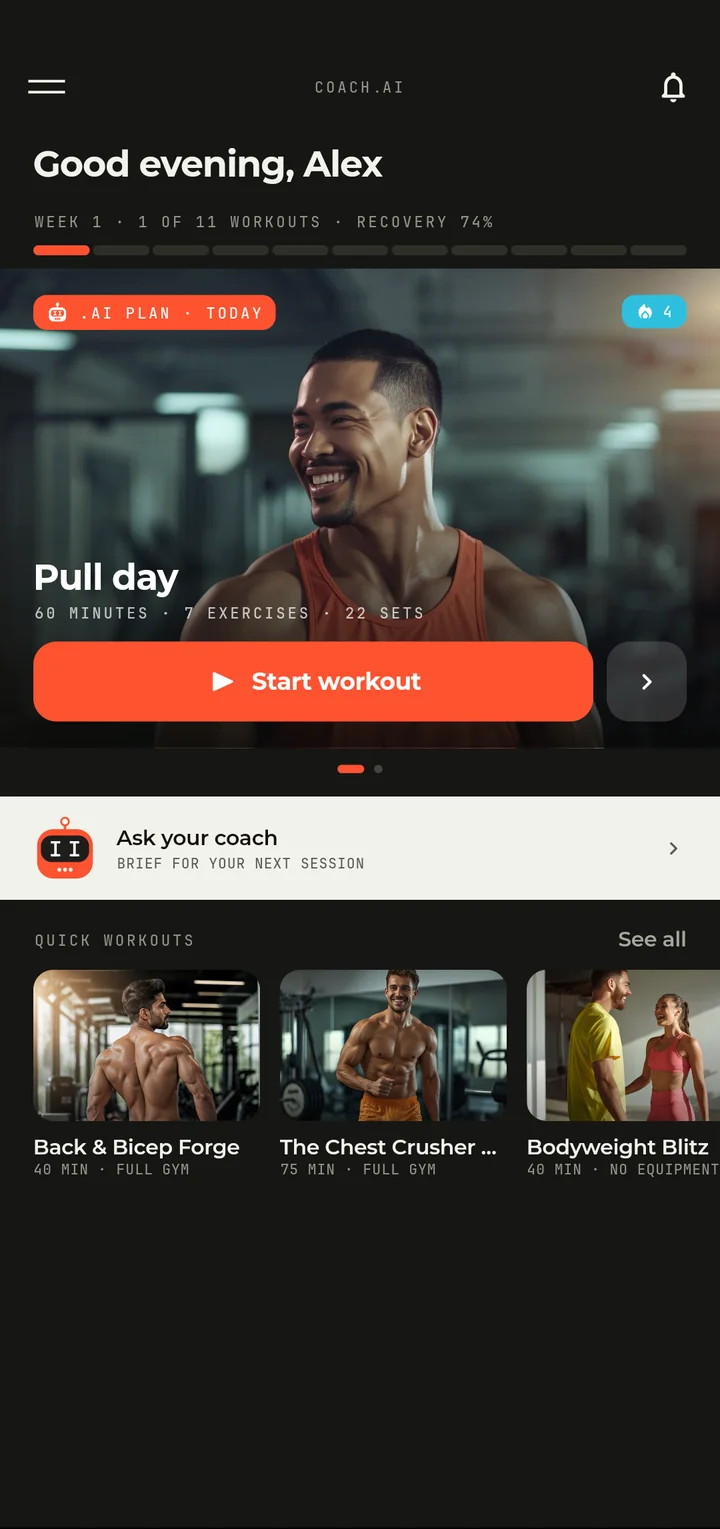
After each set you can rate how hard it felt, and before each workout there is a short check-in about sleep, food and mood. If your sets keep coming out hard and your mornings keep coming out low, the next week gets built lighter, even if it is not a fourth week. The coach tells you on the Home screen and explains why, so a lighter week never looks like the plan just stopped. As soon as you recover, the load grows again.
Why beginners don't get one
New to the gym? Coach.AI gives you no lighter weeks, planned or early, and that is on purpose. A beginner has very little fatigue to shed, and what you need most is practice with the movements. A lighter week would cost you a week of learning and buy almost nothing. Your first lighter week comes in the last stage of the beginner level, as a step towards the next one: fewer sets, same weight. The exception is age: from 60, recovery becomes the main limit, so the lighter week is part of the plan at every level. The beginner full body program shows what those first weeks look like.
Questions people ask
How often should I take a deload week?
Every four to eight weeks of hard training is the usual range. People who train hard and heavy tend to need it closer to every four weeks, which is why Coach.AI makes every fourth week lighter. Beginners can usually go much longer.
Will I lose muscle during a deload?
No. A week of lighter training is far too short to lose muscle or strength. You still lift, so your muscles still have a reason to stay. Most people come back feeling stronger, not weaker.
Can I skip the deload if I feel great?
You can, but feeling great is often the sign that the rhythm is working. A lighter week costs very little, and it is much easier to take one while you feel fine than to fix things once a lift stalls or a shoulder complains.
Should I take a deload or a full week of rest?
Tired from training: deload, keep the routine and come back sharper. Sick, injured or overwhelmed: rest fully. To see where the lighter week sits in a whole plan, browse the programs, for example push pull legs.