Muscle soreness after a workout usually shows up 12-24 hours later, peaks on the second day and fades within three to five days. It is normal, especially after new exercises or your first weeks in the gym. Gentle movement, sleep and enough food help it pass. It is not proof of a good workout, and it should feel like a dull ache, not a sharp pain.
What muscle soreness after a workout is
The ache that arrives the day after training has a name: delayed onset muscle soreness, or DOMS. It comes from small amounts of strain in the muscle fibres and the repair work that follows, especially after movements your body is not used to.
It is not lactic acid. The burn you feel during a hard set does come with lactate, but your body clears that within an hour or so. The stiffness on the stairs the next morning is a different thing.
Why is day 2 soreness worse?
Right after training you usually feel fine, maybe a little tired. The soreness builds overnight and is often worst on day two, because the repair process and the swelling that comes with it take time to peak.
So if you wake up fine after leg day and can barely sit down the morning after, nothing went wrong. That is the usual timeline.
How long does muscle soreness usually last?
| Day | What it usually feels like |
|---|---|
| Training day | Tired, maybe a little pumped |
| Day 1 | Stiff, tender to the touch |
| Day 2 | Often the worst |
| Days 3-5 | Fading |
Very hard or very new sessions can leave you sore for four or five days. Muscle soreness after a workout that is not going away after a week, keeps getting worse, or stops you moving normally is no longer the usual kind, and it is worth getting checked.
Do sore muscles mean I'm getting stronger?
No, and that is good news. Soreness tells you a session was new or unusually hard for you, not that it was effective. After a few weeks of the same exercises most people barely get sore at all, while they keep getting stronger.
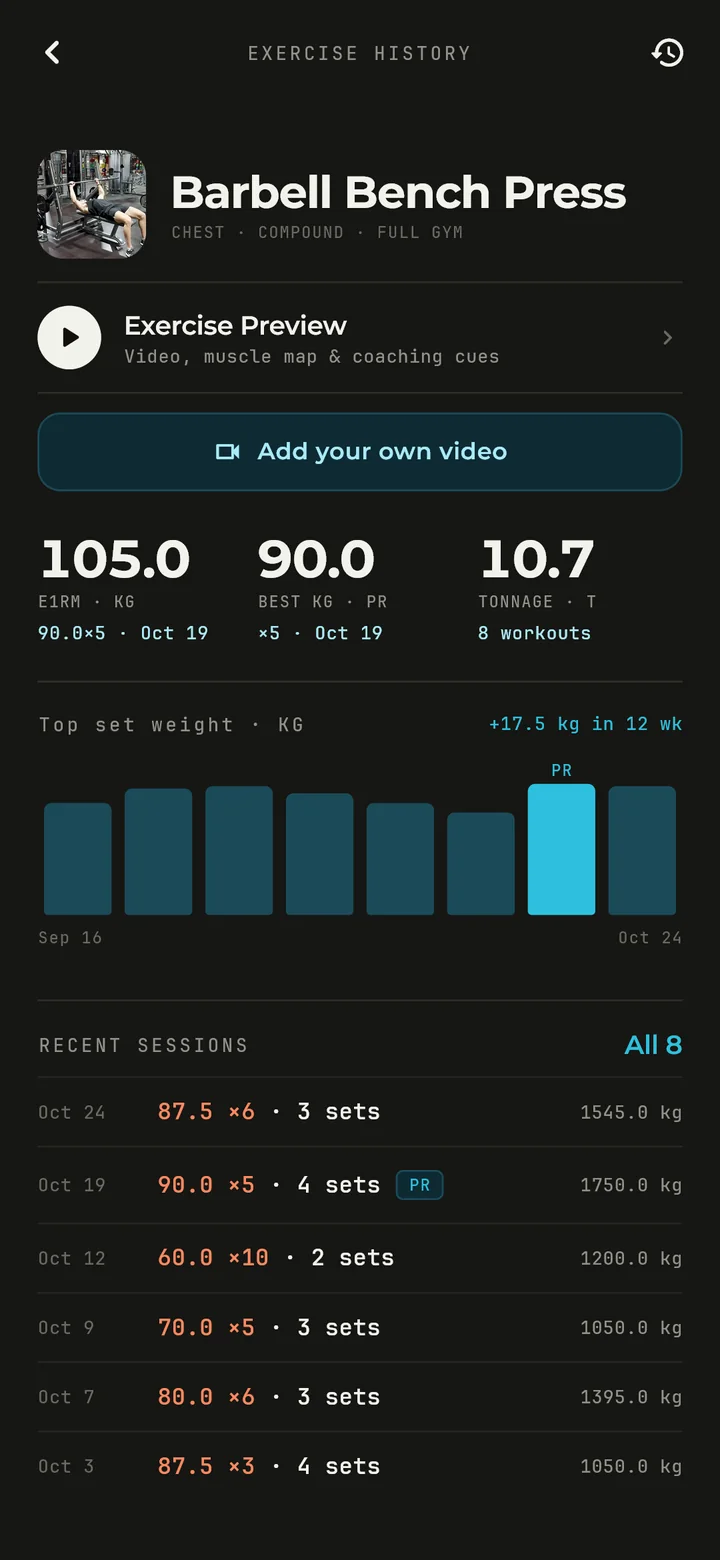
Not being sore after a workout does not mean it didn't work. The thing to watch is your logbook: if the weights or reps creep up over the weeks, you are making progress. If you want the full picture, read how progressive overload works.
Should I work out if I'm sore?
With mild or moderate soreness, usually yes. A light session often makes you feel better, because moving warms the muscles up and the stiffness eases. A few options:
- Train other muscles today. Sore legs are no reason to skip an upper body day.
- Train the sore muscles lighter, with fewer sets, and see how the first warm-up set feels.
- If the soreness changes how you move, pick other exercises or rest that muscle a day longer.
With severe soreness, where walking down stairs is a project, rest or do something easy like walking. Training hard on a muscle that can barely work rarely gives you a good session.
What helps sore muscles
- Easy movement. A walk, a light bike ride, an easy set of the same exercise. It does more than lying on the couch.
- Sleep. Most repair happens while you sleep.
- Enough food and protein. Muscles need material to rebuild.
- Warmth, massage, a foam roller. They mostly help you feel better for a while, and that is a fine reason to use them.
Static stretching after training feels nice but does little to prevent soreness. For painkillers or supplements, ask a doctor or pharmacist rather than a blog.
Soreness or injury: how to tell the difference
| Muscle soreness | Possible injury |
|---|---|
| Appears a day later | Appears suddenly, during a set |
| Dull ache over the whole muscle | Sharp pain in one spot |
| Usually on both sides | Often on one side |
| Eases as you move | Gets worse when you move |
| Gone in a few days | Stays or grows |
See a doctor if the pain is sharp, sits in a joint, comes with swelling or bruising, or does not improve after a week. Get help the same day if you have severe muscle pain and weakness after a very hard session together with very dark, cola-coloured urine: that can be a sign of a serious condition and needs medical attention.
How to be less sore next time
Most bad soreness comes from doing too much too soon: a long first session, a brand new exercise for five hard sets, or a big jump in weight. Start light, add a little each week, and repeat the same exercises for a while. After two or three sessions of the same movement your body adapts and the soreness shrinks a lot. If you're new, how much weight to start with explains how to pick a first weight that won't leave you limping.
What Coach.AI does on a sore day
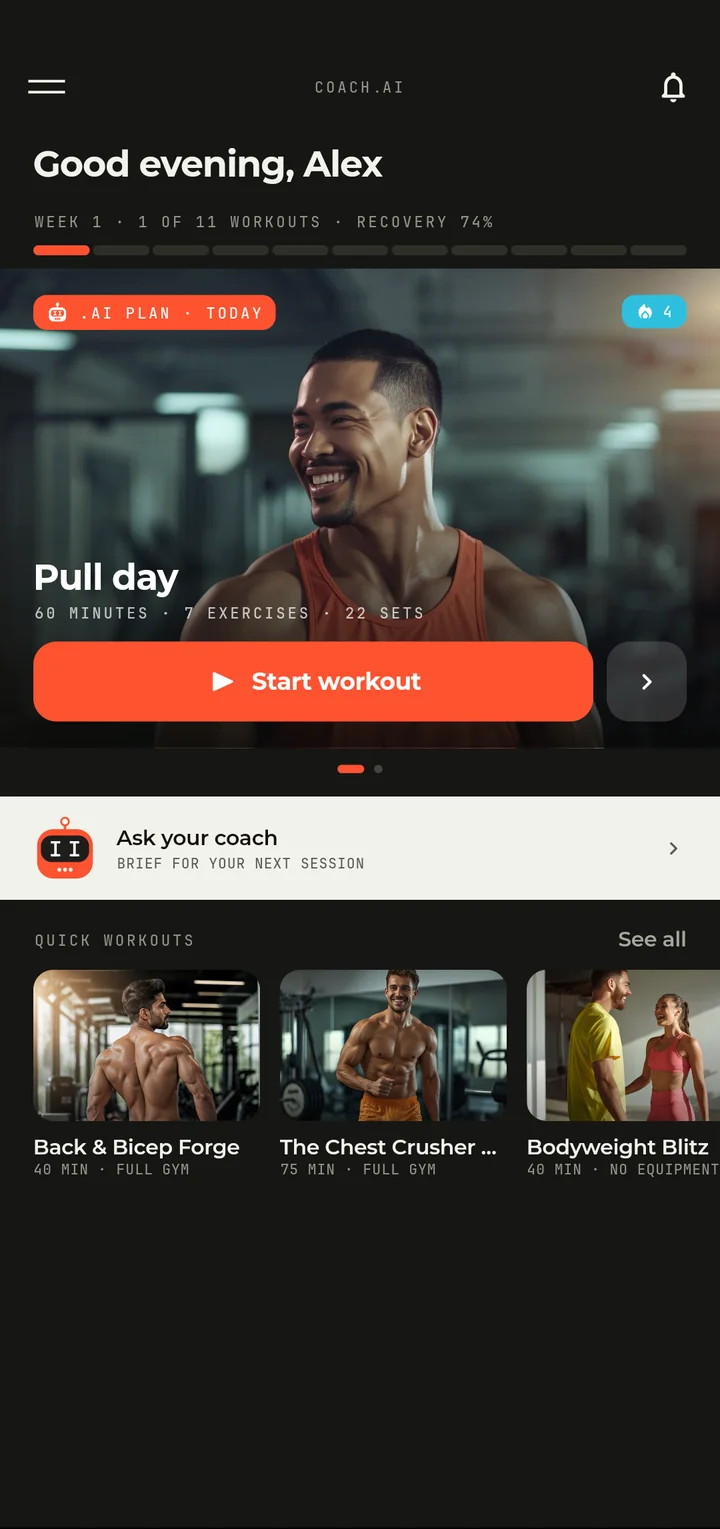
On the Home screen you can ask the coach for help with the chip "I'm sore: fix my week". The app first reminds you that this is not medical advice. Then you pick the sore areas and, if you like, add a few words, such as "left knee". The coach rewrites the rest of the week, replacing or removing exercises that load those areas, shows you the edits, and you decide whether to apply them. This uses one .AI generation.
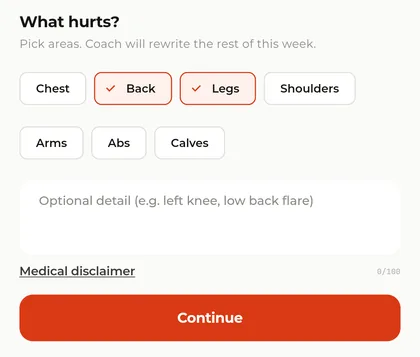
If something hurts long term, write it in the questionnaire when you build a plan. Coach.AI leaves out the movements that load that area every week, not just today. And because the next weight comes from the sets you actually logged, the plan grows in small steps, which is the best protection against the kind of soreness that ruins a week.
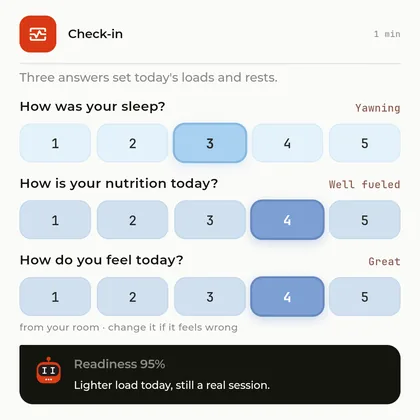
Before each workout there is also a quick check-in about sleep, food and mood. On a rough day it makes the suggested weights a little lighter. The app does not diagnose anything: it changes the training, and for real pain the right place is still a doctor.
Questions people ask
Should I skip a workout if I'm sore?
Usually not. With mild soreness, train as planned or train other muscles, and let the warm-up tell you how it goes. Skip or rest only when the soreness is severe or changes how you move.
Is it normal not to be sore after a workout?
Yes. Soreness fades as your body gets used to the exercises. What shows progress is your log: more weight or more reps over the weeks.
Why am I still sore 4 days after working out?
A very hard or very new session can do that, especially in your first weeks or after a long break. If it lasts beyond a week, gets worse, or comes with swelling or joint pain, see a doctor.
Does stretching prevent muscle soreness?
Not much. Stretching can feel good, but the best way to get less sore is to build up gradually and keep training the same movements regularly.