Start with a weight you can lift for every rep on the card with two or three reps still in the tank and clean form on all of them. That is usually lighter than you expect. Your first sessions are for finding your numbers, not for testing them.
The first weight matters less than you think
The first time in a gym, the question "how much should I put on?" feels like a test you can fail. It isn't. The first weight is a guess, and what matters is the next set.
Too light costs you almost nothing: you add a little and the next set is closer. Too heavy is the expensive mistake. Form breaks, a joint complains, and the first session quietly becomes the last one. If you are going to miss, miss light.
The feel you are looking for: two or three reps left
A good working set ends with two or three reps left in the tank. The last reps are slow and take real effort, but you could still do a couple more with clean form.
You are in the right place when the first reps move easily, the last two or three get noticeably harder, and your form on the last rep looks the same as on the first. If the bar flies up at the end, it is too light. If you have to twist, bounce or hold your breath to finish, it is too heavy.
How to find your working weight in the first session
- Do one light set first. An empty bar, the lightest pin on the machine or small dumbbells, for ten easy reps.
- Pick a first working weight that looks almost too easy. Torn between two numbers? Take the lower one.
- Do the set and judge it honestly. How many more reps were left?
- Adjust before the next set. Very easy: add 10-20%. Right: keep it. A grind, or missed reps: take about 10% off.
- Write down the weight and reps of every set.
By the second or third set you will usually have it. That number is your working weight for now and the starting point for next time.
Machines first is completely fine
You don't have to start with a barbell. Machines guide the movement, so you can focus on effort instead of balance, and the weight changes with one pin. A leg press, a chest press, a seated row and a shoulder press machine cover the whole body.
That is how our 3-day beginner program starts: the first week repeats the same four base lifts on machines in every session, two sets of ten. By the third session you know the machines, you know your numbers, and you can see the weight starting to climb.
The other free programs on this site lay out their first week the same way, day by day.
One catch: the number on a stack means something different in every gym, so treat your first set on any new machine as a test.
A rough starting point by body weight
If you still want a number to aim at, here is the honest version. These are the fractions of body weight that Coach.AI's own first estimate is built on, for a beginner around 30 at a healthy weight for their height. They are for about 8 reps with a barbell, rounded to 2.5 kg.
| Lift | Men | Women | 70 kg man | 60 kg woman |
|---|---|---|---|---|
| Squat | 60% | 45% | 42.5 kg | 27.5 kg |
| Deadlift | 75% | 55% | 52.5 kg | 32.5 kg |
| Bench press | 50% | 30% | 35 kg | 17.5 kg |
| Barbell row | 45% | 32% | 32.5 kg | 20 kg |
| Overhead press | 35% | 22% | 25 kg | 12.5 kg |
Read it as a rough start, not a standard. The feel from above always wins over the table, and for 10 or 12 reps go a little lighter.
- An empty Olympic bar weighs 20 kg. If your number is below that, the bar alone is your first set, or use dumbbells or a lighter fixed bar.
- A pair of dumbbells carries about four fifths of the barbell figure in total. One dumbbell held in both hands, as in a goblet squat, is about 40% of it.
- If you came to lose weight, don't multiply your full body weight. A heavier body is not a reason for a heavier bar on day one.
Write it down, then let the log lead
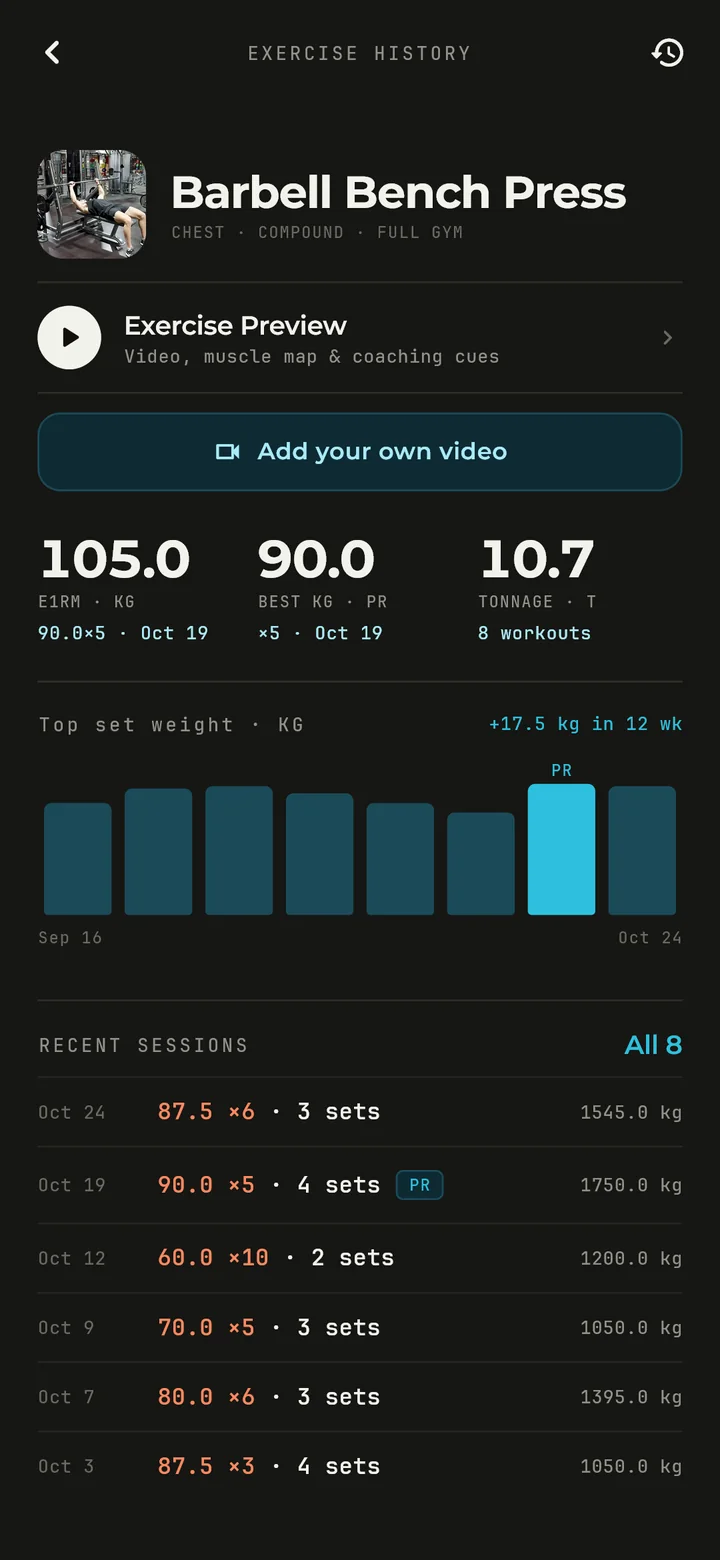
The most useful habit of your first month is boring: write down every set, with a word on how it felt. Next session you start from what you actually did. Easy, go up a step. Right, stay and own it. A grind, come down a little. To turn a recent set into a working weight for a different number of reps, use the 1RM calculator.
How Coach.AI picks your first weight
Coach.AI starts from the same table. It reads your body weight, sex, age and level and puts the result in the weight field as a suggestion you can change. Your weight is only read up to the top of the healthy range for your height, and on machines a beginner gets about two thirds of the free weight estimate, because stacks differ between gyms. The plan's number always means a weight for about 8 reps, and the session screen lowers it when the card asks for more.
Your first two loaded exercises open with two warm-up sets at about half and 70% of the working weight. For the first three weeks a beginner also sees a short coach note under each set: start with the suggested weight, the last two or three reps should feel hard with clean form, and if it is too heavy, take it down a step.
After each set the rest timer asks how it felt. "Very easy" suggests 20% more, "Easy" 10% more, "Just right" keeps it, "Hard" about 5% less and "Very hard" 10% less. Next session the exercise starts from your best set that hit its reps and felt "Just right" or "Hard". So the first guess only has to be close.
Questions people ask
How do I know if the weight is too heavy?
Your form changes before your muscles give up. If you bounce, twist, lean back or hold your breath to finish, or you miss reps the card asked for, it is too heavy. Take about 10% off and do the next set clean.
Should I lift to failure as a beginner?
No. Stopping with two or three reps left builds strength and muscle well, keeps your form clean and leaves you fresh for the next set and the next session.
How fast will the weights go up?
Quickly at first, because early progress is mostly your body learning the movement. A small step every session or week is normal for a while. When the reps stop coming, stay at that weight until they do.
Should I start with dumbbells or machines?
Either works. Machines are easier to learn and to load, so they are a calm place to start. Dumbbells need more balance. Many beginners use machines for the big lifts and add dumbbells once the movements feel familiar.